
Managed IT Services

Allowing you to focus on maintaining a secure, efficient system without firefighting the daily challenges.

OVERVIEW

Managed IT Services – Simplified

What Are Managed IT Services

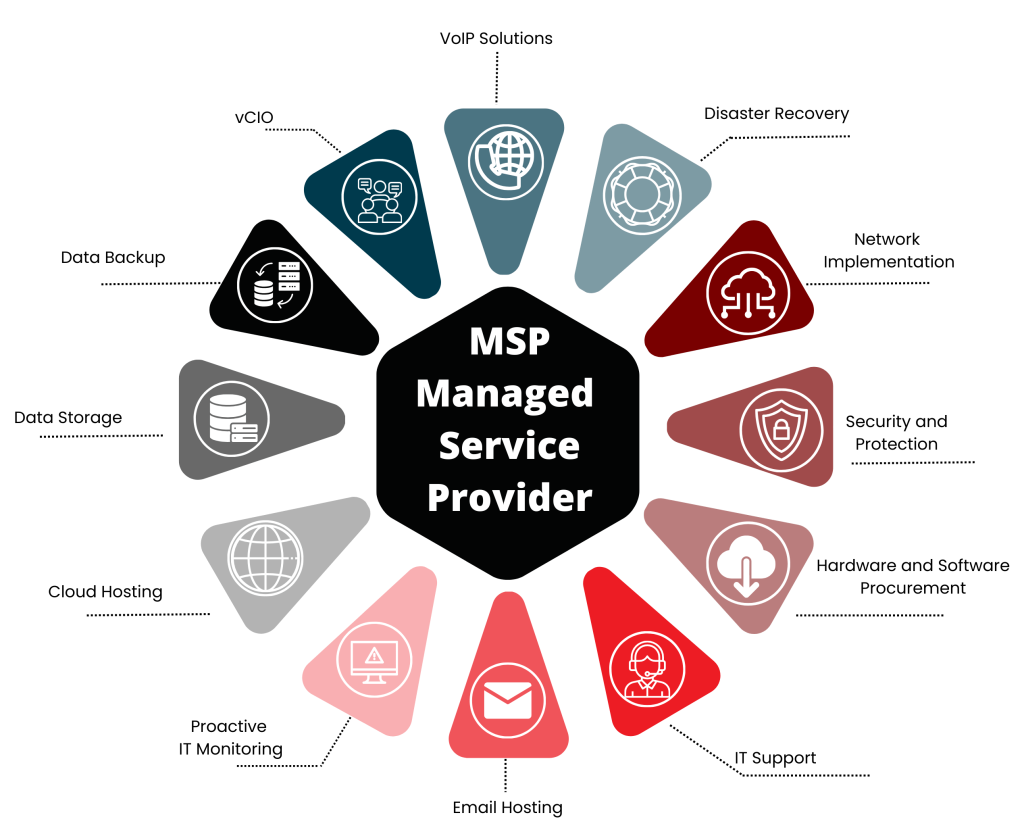
Managed IT Services and Managed Service Providers (MSPs) offer proactive, outsourced IT support and infrastructure management.

Managed IT Services shift away from the traditional model of break-fix, and instead pivot to a proactive approach of consistently monitoring your system to keep it operational and protected.  

Why Do Managed IT Services Matter?

Businesses need more than just reactive tech support—they need proactive, strategic IT management. Managed IT Services provide exactly that by outsourcing critical IT functions to expert providers. This ensures your systems stay secure, efficient, and up-to-date, while freeing your internal teams to focus on innovation and growth.

What Do Managed IT Services Include?

  • 24/7 Monitoring
  • Helpdesk Support & Service
  • Cybersecurity
  • Backup & Disaster Recovery
  • Cloud Management
  • Intrusion Prevention
  • Firewall Support & Service
  • Anti-Virus/Anti-Malware

Client Testimonials

Learn How An MSP Can Help You Grow

PEOPLE SERVICES

Your IT Department - Extended

Virtual Chief Information Officer (vCIO)

A vCIO, or Virtual Chief Information Officer, is a third-party technology advisor or consultant who performs the functions of a traditional Chief Information Officer (CIO) but on a part-time, remote, or contract basis. vCIOs are commonly used by small to mid-sized businesses that may not have the resources to hire a full-time CIO.

Tech Leaders Are Increasing IT Investment

94%

Despite ongoing economic uncertainty, 94% of technology executives plan to increase their IT spending in the next year.

EY Survey

A vCIO aligns a company’s IT strategy with its business goals. They focus on Strategic IT Planning & Roadmapping, Managing Risk, Budgets and ROI, Overseeing Application Lifecycles, Governance, and Vendor Management.

Learn More

Technology Roadmap
Establish hardware and software life cycles in alignment with planned business growth.
IT Budget
Aligned with technology roadmap, determine schedules with projected costs for procurement and implementation.
Cost Control
Expense analysis and review of third-party vendor solutions and services.
Stabilize the Client’s Environment
Scope, assess, and align our security and hosting services to provide stable and scalable solutions.
Alignment of Technology to Business
Identify specific business requirements and alignment to technology solutions.
Business Downturn Planning
In the event of a downturn in business, work together to craft solutions to support sustaining business operations.
Alignment of Technical Solutions
Ensure technology meets compliance requirements.
Cyber Insurance Applications
Guidance on cyber insurance application processes and aligning of solutions to potential gaps.
Cyber Incident Response
In the event of a breach, serve as point person for response and incident management tracking.
Risk Assessment Representation
Advise and participate in formal risk assessment procedures including risk meetings and reviews.
SWOT Analysis
Perform technology SWOT analyses and review with the leadership team.
O365/M365 Security Review
Produce and review Microsoft Security Score. Review opportunities for remediation to enhance score.
IT Disaster Recovery
Collaboratively determine appropriate risk factors and create an IT Disaster Recovery plan as part of business continuity.
3rd-Party Risk Management
Ensure third parties meet contractual and regulatory security requirements.
3rd-Party Service Provider Management
Manage relationship with other service providers including ISP, app providers, and print providers.
Contract Review and Execution
As delegated, review and execute IT contracts.
Stakeholder Communication
Provide guidance to procurement, legal, and business units on secure vendor selection.
Incident Management & Escalation
Ensure vendors have incident response plans and are contractually obligated to report breaches.
SWOT Analysis
Perform technology SWOT analyses and review with the leadership team.
O365/M365 Security Review
Produce and review Microsoft Security Score. Review opportunities for remediation to enhance score.
IT Disaster Recovery
Collaboratively determine appropriate risk factors and create an IT Disaster Recovery plan as part of business continuity.
3rd-Party Risk Management
Ensure third parties meet contractual and regulatory security requirements.
Human Resources Administration and Staff Reviews
As delegated, review and administration of time off and time and attendance matters.
Managing Client Teams
When delegated, manage the client's internal IT teams.
Invoice Approval
As delegated, approve vendor invoices ensuring that expenses are in alignment with IT budget and contracts.
Audit Remediation
Review and implement, as appropriate and approved, audit remediation plans.
Project Management
Ensure projects are managed and completed according to plan.
Space and Infrastructure Planning
Consult on technology requirements, MDF, IDF, and cable plant services for office build, moves, and expansion.
Escalation Point
Whether related to a client emergency or service and delivery, be a contact for escalation.

Virtual Chief Information Security Officer (vCISO)

The Virtual Chief Information Security Officer (vCISO) plays an integral part in development of strategic policy, technology planning and investments in Information Security technology. The CISO is an expert advisor to executive leadership, senior management, and across the organization reaching into departments such as information technology, operations, and communications.

Tech Leaders Are Increasing IT Investment

94%

Despite ongoing economic uncertainty, 94% of technology executives plan to increase their IT spending in the next year.

EY Survey

The Virtual Chief Information Security Officer (vCISO) plays an integral part in development of strategic policy, technology planning and investments in Information Security technology. The CISO is an expert advisor to executive leadership, senior management, and across the organization reaching into departments such as information technology, operations, and communications.

Learn More

Security Strategy & Governance
Develop and maintain the cybersecurity strategy aligned with business goals.
Regulatory & Compliance Oversight
Ensure compliance with relevant regulations (e.g., GDPR, HIPAA, CCPA, PCI-DSS).
Security Architecture & Program Development
Guide the design of secure systems and networks.
Incident Response & Business Continuity
Develop and test incident response plans and disaster recovery strategies.
Executive & Board Communication
Provide regular briefings on security posture, risks, and initiatives.
Security Awareness & Culture
Promote a security-first culture across the organization.
Risk Identification
Conduct risk assessments across systems, processes, and third parties.
Risk Analysis & Prioritization
Use frameworks like NIST RMF, ISO 27005, or FAIR to guide analysis.
Risk Mitigation Planning
Develop and recommend risk treatment plans (avoid, transfer, mitigate, accept).
Risk Monitoring & Reporting
Establish continuous monitoring processes for key risk indicators (KRIs).
Integration with Business Strategy
Ensure risk management is embedded in business planning and decision-making.
Policy & Framework Development
Develop and maintain risk management policies and procedures.
Testing & Exercises
Test the effectiveness of incident response and business continuity plans.
3rd-Party Risk Management
Ensure third parties meet contractual and regulatory security requirements.
Contract & SLA Review
Ensure contracts include security and privacy clauses.
Ongoing Monitoring
Implement a continuous monitoring program for high-risk vendors.
Stakeholder Communication
Provide guidance to procurement, legal, and business units on secure vendor selection.
Incident Management & Escalation
Ensure vendors have incident response plans and are contractually obligated to report breaches.
Security Program Implementation
Translate the cybersecurity strategy into operational plans and roadmaps.
Security Operations Oversight
Direct the day-to-day activities of the Security Operations Center (SOC) or MSSP.
Vulnerability & Threat Management
Oversee vulnerability scanning, patch management, and threat intelligence integration.
Identity & Access Management (IAM)
Enforce least privilege access, role-based access control (RBAC), and multi-factor authentication (MFA).
Policy Enforcement & Control Validation
Ensure security policies are operationalized through technical and administrative controls.
Tooling & Technology Management
Evaluate, select, and implement security tools (e.g., SIEM, EDR, DLP, CASB).
Metrics & Reporting
Define and track Key Performance Indicators (KPIs) and Key Risk Indicators (KRIs).
Team Enablement & Training
Provide tactical guidance to IT and security teams.

Virtual Chief Information Officer (vCIO)

A vCIO, or Virtual Chief Information Officer, is a third-party technology advisor or consultant who performs the functions of a traditional Chief Information Officer (CIO) but on a part-time, remote, or contract basis. vCIOs are commonly used by small to mid-sized businesses that may not have the resources to hire a full-time CIO.

What Does a vCIO Do?

A vCIO aligns a company’s IT strategy with its business goals. They focus on Strategic IT Planning & Roadmapping, Managing Risk, Budgets and ROI, Overseeing Application Lifecycles, Governance, and Vendor Management.

Learn More

When Does It Make Sense to Bring in a vCIO?

What are their Key Responsibilities?

Technology Roadmap
Establish hardware and software life cycles in alignment with planned business growth.
IT Budget
Aligned with technology roadmap, determine schedules with projected costs for procurement and implementation.
Cost Control
Expense analysis and review of third-party vendor solutions and services.
Stabilize the Client’s Environment
Scope, assess, and align our security and hosting services to provide stable and scalable solutions.
Core Application Integration
Review vendor selection and specifications for third-party integrations.
Alignment of Technology to Business
Identify specific business requirements and alignment to technology solutions.
Collaboration Systems
Review and recommend appropriate solutions for telephony (VoIP), workgroup, and enterprise collaboration.
Business Downturn Planning
In the event of a downturn in business, work together to craft solutions to support sustaining business operations.
Mergers & Acquisition Planning and Execution
Advisement of IT on client merger and acquisition assessments, scalability and due diligence.
Threat Awareness
Communicate current trends in threats and known vulnerabilities with recommendations to mitigation.

In-House CIO Salary

245K

According to Glassdoor, hiring an in-house CIO can run businesses between $245K to $428K annually. To solve this challenge, the role of a vCIO was born.

Glassdoor
Alignment of Technical Solutions
Ensure technology meets compliance requirements.
Cyber Insurance Applications
Guidance on cyber insurance application processes and aligning of solutions to potential gaps.
Cyber Incident Response
In the event of a breach, serve as point person for response and incident management tracking.
Risk Assessment Representation
Advise and participate in formal risk assessment procedures including risk meetings and reviews.
SWOT Analysis
Perform technology SWOT analyses and review with the leadership team.
O365/M365 Security Review
Produce and review Microsoft Security Score. Review opportunities for remediation to enhance score.
IT Disaster Recovery
Collaboratively determine appropriate risk factors and create an IT Disaster Recovery plan as part of business continuity.

Tech Leaders Are Increasing IT Investment

94%

Despite ongoing economic uncertainty, 94% of technology executives plan to increase their IT spending in the next year.

EY Survey
3rd-Party Service Provider Management
Manage relationship with other service providers including ISP, app providers, and print providers.
Contract Review and Execution
As delegated, review and execute IT contracts.

Vendor Management Requires Significant Investment

$55K

Vendor Management business requires significant upfront investment in payroll and technology infrastructure, leading to high initial running costs In 2026, expect monthly fixed overhead (excluding variable costs) to average around $54,167, with many vCIO services, vendor management is included

Vendor Management Costs
Human Resources Administration and Staff Reviews
As delegated, review and administration of time off and time and attendance matters.
Managing Client Teams
When delegated, manage the client's internal IT teams.
Invoice Approval
As delegated, approve vendor invoices ensuring that expenses are in alignment with IT budget and contracts.
Audit Remediation
Review and implement, as appropriate and approved, audit remediation plans.
Project Management
Ensure projects are managed and completed according to plan.
Space and Infrastructure Planning
Consult on technology requirements, MDF, IDF, and cable plant services for office build, moves, and expansion.
Escalation Point
Whether related to a client emergency or service and delivery, be a contact for escalation.

Cyberattacks Through IT Assets

76%

Every unmanaged device, forgotten server, and unpatched system represents a potential entry point for attackers. Studies reveal that 76% of organizations have experienced cyberattacks through unknown, unmanaged, or poorly managed IT assets exposed to the internet. A vCIO improves IT governance by aligning technology strategies with business goals, establishing compliance frameworks, and managing risks proactively rather than reactively.

Attack Stats

Virtual Chief Information Security Officer (vCISO)

A vCIO, or Virtual Chief Information Officer, is a third-party technology advisor or consultant who performs the functions of a traditional Chief Information Officer (CIO) but on a part-time, remote, or contract basis. vCIOs are commonly used by small to mid-sized businesses that may not have the resources to hire a full-time CIO.

What Does a vCISO Do?

A vCISO aligns a company’s IT strategy with its business goals. They focus on Strategic IT Planning & Roadmapping, Managing Risk, Budgets and ROI, Overseeing Application Lifecycles, Governance, and Vendor Management.

Learn More

When Does It Make Sense to Bring in a vCISO?

What are their Key Responsibilities?

Security Strategy & Governance
Develop and maintain the cybersecurity strategy aligned with business goals.
Regulatory & Compliance Oversight
Ensure compliance with relevant regulations (e.g., GDPR, HIPAA, CCPA, PCI-DSS).
Security Architecture & Program Development
Guide the design of secure systems and networks.
Incident Response & Business Continuity
Develop and test incident response plans and disaster recovery strategies.
Executive & Board Communication
Provide regular briefings on security posture, risks, and initiatives.
Security Awareness & Culture
Promote a security-first culture across the organization.

In-House CISO Salary

255K

According to Glassdoor, hiring an in-house CISO can run businesses between $255K to $420K annually. To solve this challenge, the role of a vCIO was born.

Glassdoor
Risk Identification
Conduct risk assessments across systems, processes, and third parties.
Risk Analysis & Prioritization
Use frameworks like NIST RMF, ISO 27005, or FAIR to guide analysis.
Risk Mitigation Planning
Develop and recommend risk treatment plans (avoid, transfer, mitigate, accept).
Risk Monitoring & Reporting
Establish continuous monitoring processes for key risk indicators (KRIs).
3rd-Party Risk Management
Ensure third parties meet contractual and regulatory security requirements.
Integration with Business Strategy
Ensure risk management is embedded in business planning and decision-making.
Policy & Framework Devlopment
Develop and maintain risk management policies and procedures.
Testing & Exercises
Test the effectiveness of incident response and business continuity plans.

Tech Leaders Are Increasing IT Investment

94%

Despite ongoing economic uncertainty, 94% of technology executives plan to increase their IT spending in the next year.

EY Survey
Contract & SLA Review
Ensure contracts include security and privacy clauses.
Ongoing Monitoring
Implement a continuous monitoring program for high-risk vendors.
Stakeholder Communication
Provide guidance to procurement, legal, and business units on secure vendor selection.
Incident Management & Escalation
Ensure vendors have incident response plans and are contractually obligated to report breaches.

Vendor Management Requires Significant Investment

$55K

Vendor Management business requires significant upfront investment in payroll and technology infrastructure, leading to high initial running costs In 2026, expect monthly fixed overhead (excluding variable costs) to average around $54,167, with many vCISO services, vendor management is included

Vendor Management Costs
Security Program Implementation
Translate the cybersecurity strategy into operational plans and roadmaps.
Security Operations Oversight
Direct the day-to-day activities of the Security Operations Center (SOC) or MSSP.
Vulnerability & Threat Management
Oversee vulnerability scanning, patch management, and threat intelligence integration.
Identity & Access Management (IAM)
Enforce least privilege access, role-based access control (RBAC), and multi-factor authentication (MFA).
Policy Enforcement & Control Validation
Ensure security policies are operationalized through technical and administrative controls.
Tooling & Technology Management
Evaluate, select, and implement security tools (e.g., SIEM, EDR, DLP, CASB).
Metrics & Reporting
Define and track Key Performance Indicators (KPIs) and Key Risk Indicators (KRIs).
Team Enablement & Training
Provide tactical guidance to IT and security teams.

Cyberattacks Through IT Assets

76%

Every unmanaged device, forgotten server, and unpatched system represents a potential entry point for attackers. Studies reveal that 76% of organizations have experienced cyberattacks through unknown, unmanaged, or poorly managed IT assets exposed to the internet. A vCISO improves IT governance by aligning technology strategies with business goals, establishing compliance frameworks, and managing risks proactively rather than reactively.

Attack Stats

SOFTWARE SERVICES

Your Security - Extended​

The Crucial Role of Data Backups in a Cyber-Insecure World

Cloud Infrastructure

Cloud infrastructure is hardware and software that enables users to access applications and data storage remotely, via the internet. Cloud infrastructure offers scalability, flexibility and cost-efficiency for companies by offering on-demand access. At LBMC Technology Solutions, we help clients leverage their cloud software and services; reducing costs and improving efficiency. By guiding you in selecting the right set of services, we enable organizations to maximize their resources and concentrate on driving growth.

Gain a global footprint in hours
Focus on your core business instead of IT infrastructure
Experience enterprise level IT performance, for a fraction of the cost
Keep your systems and processes, without the cost of on-site infrastructure
Firewall Illustration

Firewall Management

A firewall is the first line of defense in any cybersecurity strategy, acting as a barrier between trusted internal networks and suspicious external networks (like the internet). Firewalls safeguard your internal network by monitoring and filtering traffic in and out, using rules defined by your organization to prevent unauthorized access. LBMC Technology Solutions provides our clients the best-in-class firewall products from our industry leading partner network.

Prevent unauthorized access to your network
Control and monitor traffic flow
Secure network access for a remote or hybrid workforce
Access user and threat reports

Mobile Device Management

Mobile Device Management (MDM) empowers your team to work anywhere with secure, reliable mobile tools, regardless of operating system—keeping your data protected while boosting productivity. Using Microsoft Intune, LBMC Technology Solutions provides secure, centralized management for iOS, Windows, Android, and macOS devices within one unified platform.

Reduce risks of data breaches
Protect sensitive data regardless of device
Lock, wipe, or configure devices from a central location
Remotely troubleshoot and resolve issues, reducing downtime
MFA Illustration

Multi-factor Authentication

Multi-Factor Authentication (MFA) strengthens security by requiring users to verify their identity through two or more methods before accessing company systems. MFA adds an extra layer of security by ensuring that stolen passwords alone can’t grant access to your systems. LBMC Technology Solutions offers a range of MFA options tailored to your organization’s unique needs.

Provides stronger defense against compromised passwords
Secure networks, ensuring only verified users have access
Reduce risk of identity theft
Enhance compliance with industry standards and regulations(GDPR, HIPAA, PCI DSS)
Anti-Virus

Antivirus & Anti-Malware

Antivirus and anti-malware work hand-in-hand to protect your devices—antivirus stops computer viruses, while anti-malware defends against broader threats like worms, trojans, ransomware, and spyware. Both are critical for building a strong security layer that prevents downtime, data breaches, and costly financial or reputational damage. At LBMC Technology Solutions, we take a layered approach to security, delivering antivirus and anti-malware solutions configured for maximum protection with minimal impact on system performance.

Safeguard against hackers, viruses, malware and leaks
Peace of mind knowing your technology infrastructure is secure
Robust protection and around-the-clock monitoring
Scalable services to meet your organizations budget and evolving risk profile

Intrusion Prevention

Intrusion prevention systems (IPS) provide a proactive cybersecurity strategy that monitors network traffic for malicious activity and blocks threats in real time. Beyond supporting regulatory compliance, IPS offers deep network visibility to help organizations stay secure. At LBMC Technology Solutions, our two-part approach combines managed intrusion prevention and managed intrusion protection. We detect and stop hostile activity instantly, backed by 24/7 monitoring, to identify and report unauthorized access attempts. Every alert includes an in-depth analysis and clear, actionable steps to eliminate the threat.

Real-time detection and blocking of malicious activity
Automatic identification and mitigation of vulnerabilities
Enhanced compliance with regulatory standards
Reduced risk of costly forensic investigations and recovery

CONTACT US

Get In Touch

By providing a telephone number and submitting this form you are consenting to be contacted by SMS text message. Message & data rates may apply. You can reply STOP to opt-out of further messaging.

TechPulse Newsletter Signup

Join over 15,000 people who receive our tips every month

Scroll to Top